RSS Feed

Author Archives: Donna Black-Sword

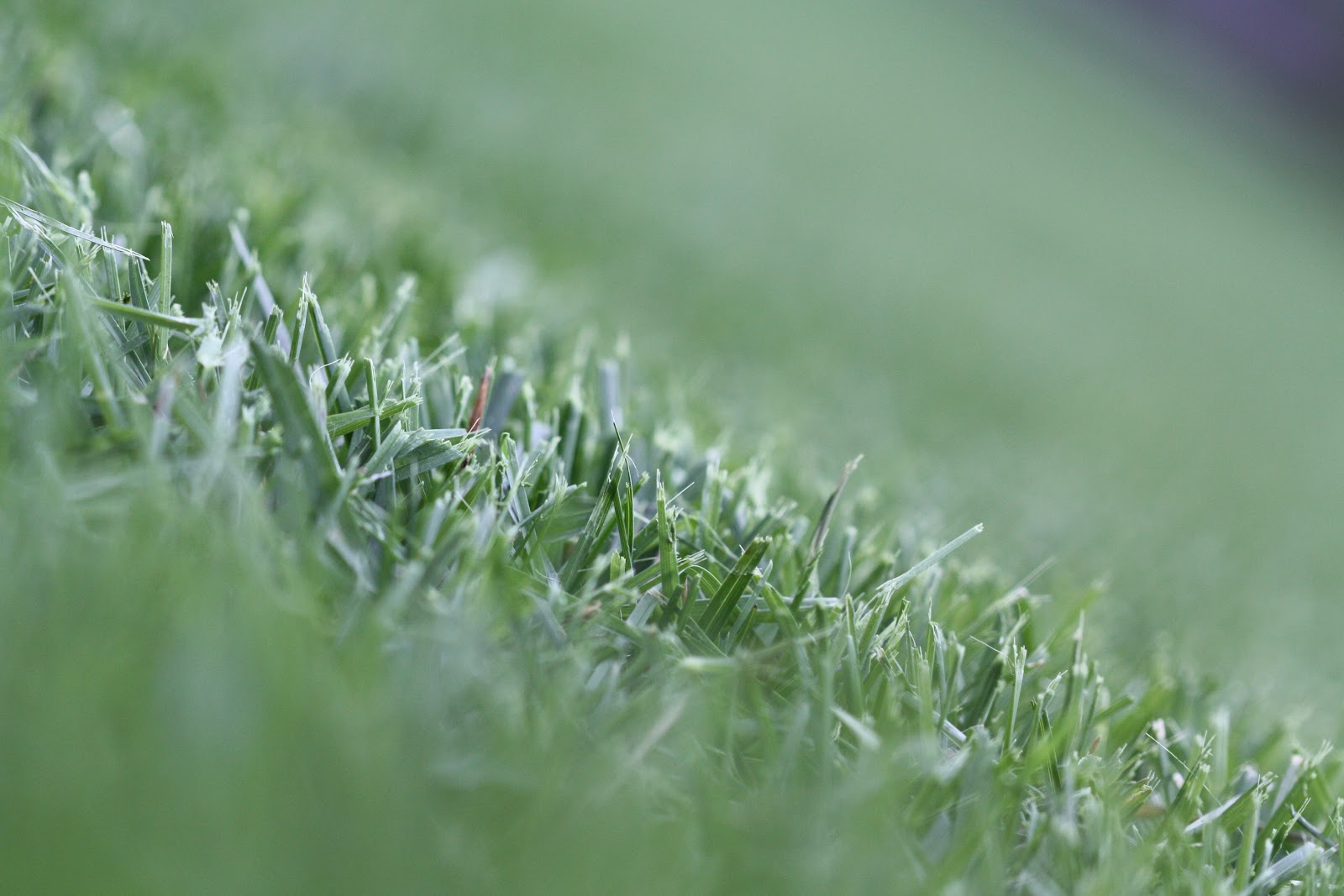
The earthy bouquet of Fescue

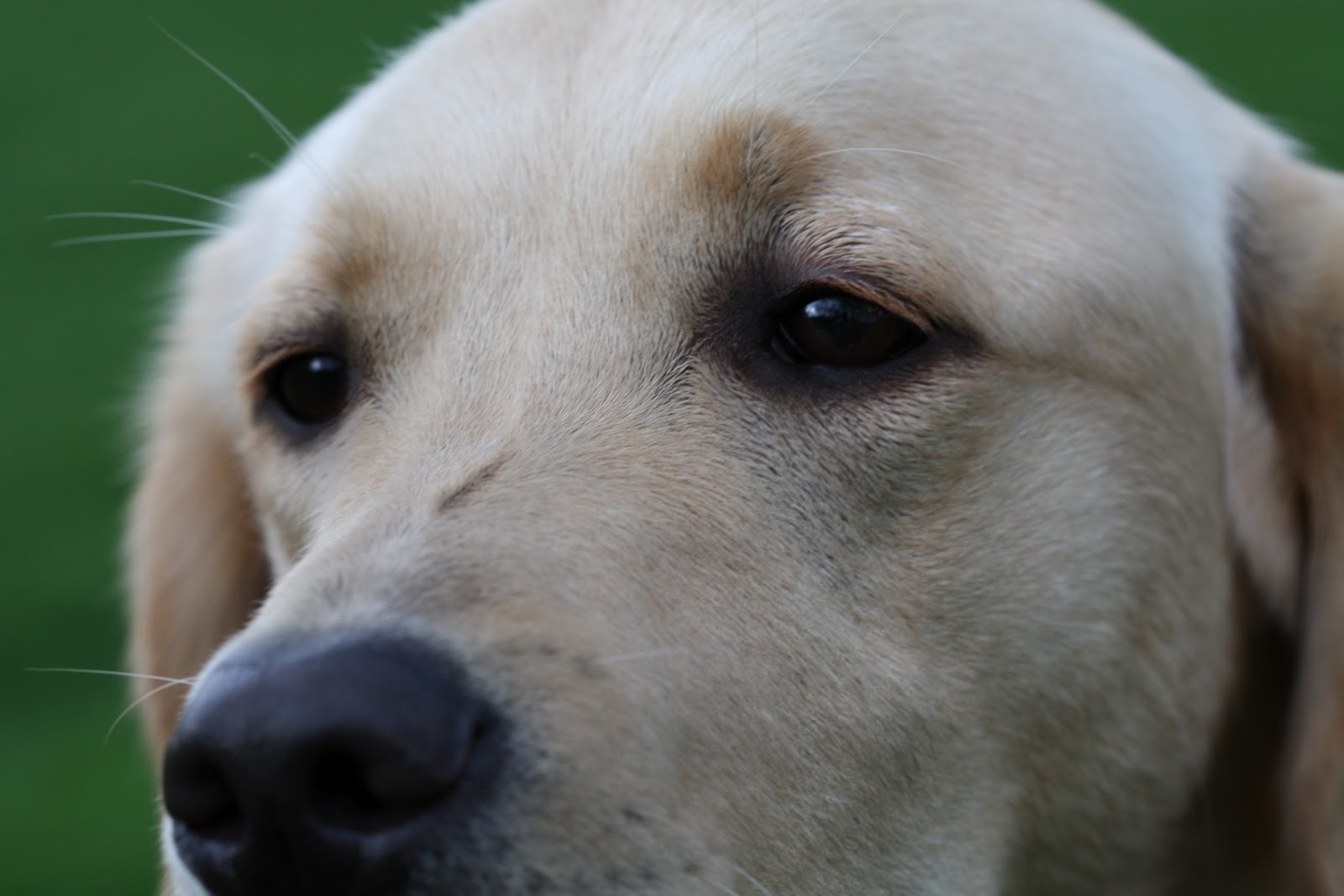
Yaxley looks upon his grassy expanse

A gorgeous summer day. And one of those workdays that we find it rather torturous to be chained to a desk, so a fine time to eat lunch outside at the picnic area. Fresh lunch meat sandwiches, purty butterflies flitting about and a handful of us are enjoying watching our dogs at play. Ah, ’tis a peaceful lunch hour.

So what is your dog? asks my co-worker and fellow puppy raiser.

What? I ask while trying not spit a Subway ham and cheese when I talk, do you mean what breed is she?  She’s a full Labrador retriever.

Are you sure? he asks.

Oh, for the love of . . . Yeah, I’m sure, I reply, getting unreasonably annoyed. Why?

Because it appears she may have some cow in her, he says.

Huh?

I move my eyes over to the lovely Inga in all her ethereal Labrador beauty. And see that indeed she’s binging upon the lawn like a cow busting out of an ill fated Weight Watchers program.  Gaa!, says I, actually losing some of my ham sub this time,  Inga! Leave it!

What is it with dogs and grass anyway? I thought that left to their own resources dogs preferred more odoriferous offerings such as an overturned kitchen garbage can.  Or heaven forbid, that elusive delicacy that is goose poop. Why this precision manicured lawn?

Oh, theories abound on this subject from all styles of experts (upset stomachs, instinctual need, dietary imbalance, the call of the wild) which really means that only dogs know the true appeal.  Some eat grass, then toss it back up later on your precious oriental rug.  Others process it through without even a cursory burp.

We do know that a dog’s sense of smell is more developed than their sense of taste. And the retrievers that have come through this household have fixated on such things that have an intriguing mouth-feel. Stuff like sticks and rocks and the occasional small toad. Does it all taste good? I’ve gotta guess that, no, probably not.  But it may have felt pretty darn good on the molars and smelled even better. At least to a dog’s value system.

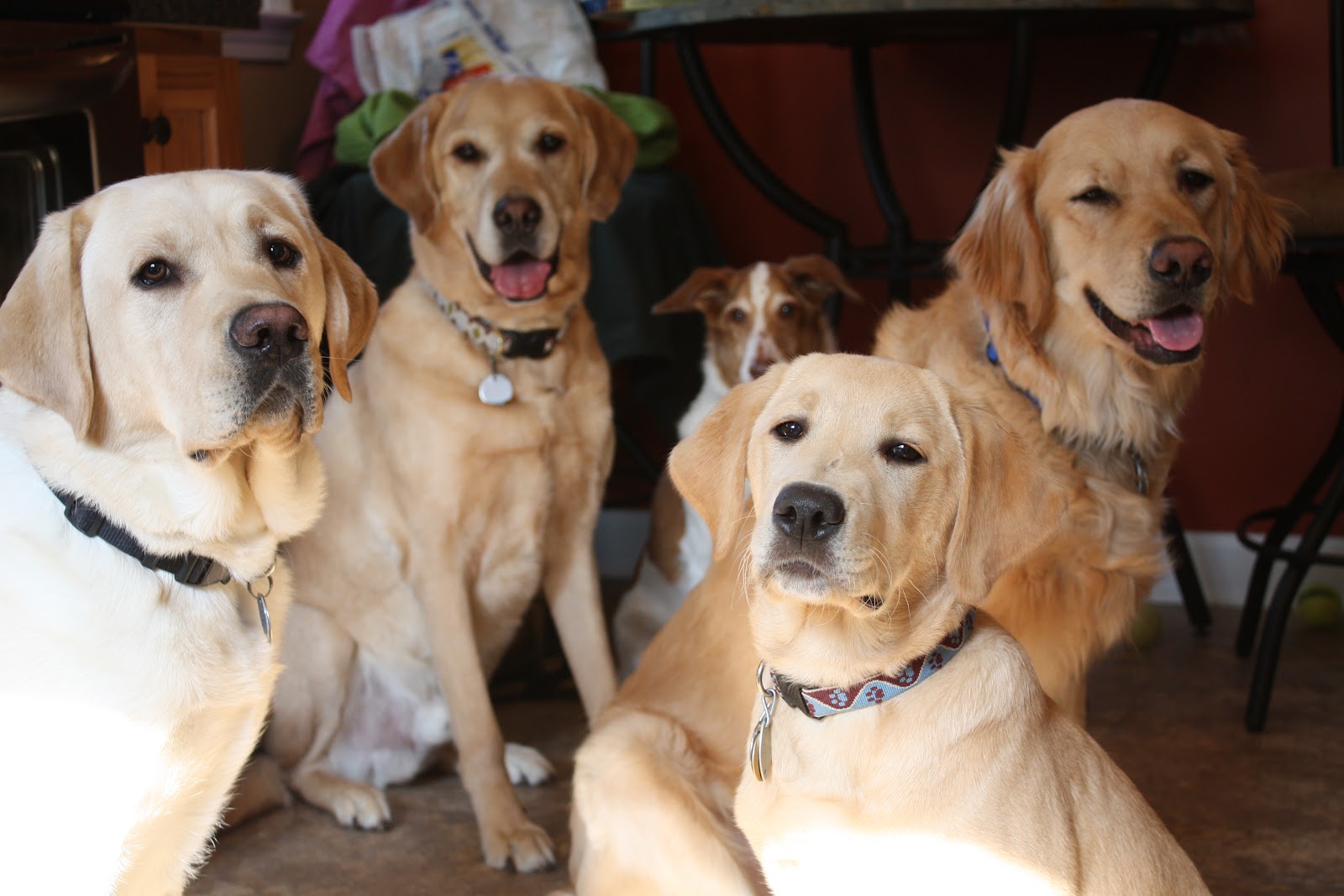
With the early Spring season we’ve been enjoying here in southwestern Ohio, our lawn is popping up very green and lush. There seems to be something about the tender, new green blades that appeals to my yeller boys. While the terrier is off ground squirrel hunting, Micron and Yaxley are channeling their bovine spirits to become One with the fresh, new fescue sprouts.

In my rather less than expert opinion, this grass noshing thing is really not a problem I spend much time pondering. I will ask my dogs to please not do that in a command that sounds exactly like Don’t!  Not because I’m inconsiderate of their instinctive dietary needs, but rather because I can never be sure if this particular salad bar has been chemically treated.  You just don’t know where that grass has been.

And actually, I do rather prefer my yellow fellows to be paying attention to what is going on beyond that tender patch of fescue, in spite of the lawn connoisseurs that they claim to be. A pup chewing cud has their noggin in a happy alternate universe where squirrels can’t climb trees and the command Here is just a buzzing sound.

And really, I tell Yaxley, it’s just not becoming of a future service dog to be seen doing such things. 

The Ohio Fescue has a herbal bouquet with a greenish aftertaste on the palate.
A domestic flavor that can’t compete with the complexity of Kentucky Bluegrass
 with its earthy undertones of red clay soil.

Whether a CCI pup or your beloved pet, I will say if it something is bothering you about your fuzzy companion to not hesitate to consult with your veterinarian. Is the grass eating behavior new or does your pup seem to have a bigger hankering than usual for the green stuff? Never (Never!, I say) ignore that gut feeling that you need double check on something. But you already knew that, didn’t you?  Who knows your dog better than you do?  Right.

Ok, now I’m off to finger swipe small sticks out of Labrador maws. And to check on what just the heck the terrier is into now. Is that a mole?  Holy cow. . . Jager!

It’s like eating an elephant. One bite at a time. [sigh]
 So much lawn  . . .
A guy can dream, can’t he?

Wordless Wednesday: Caption this #4


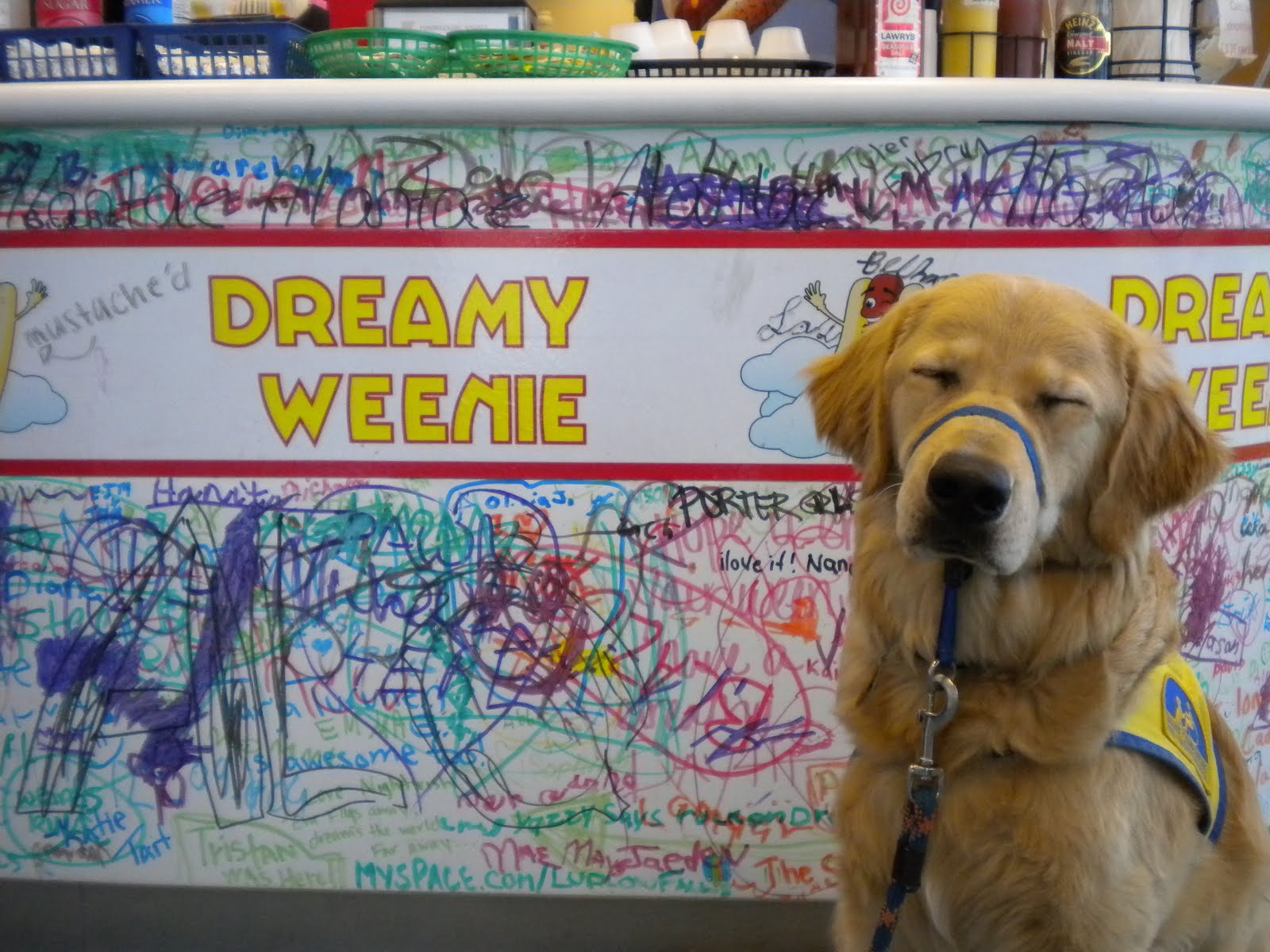
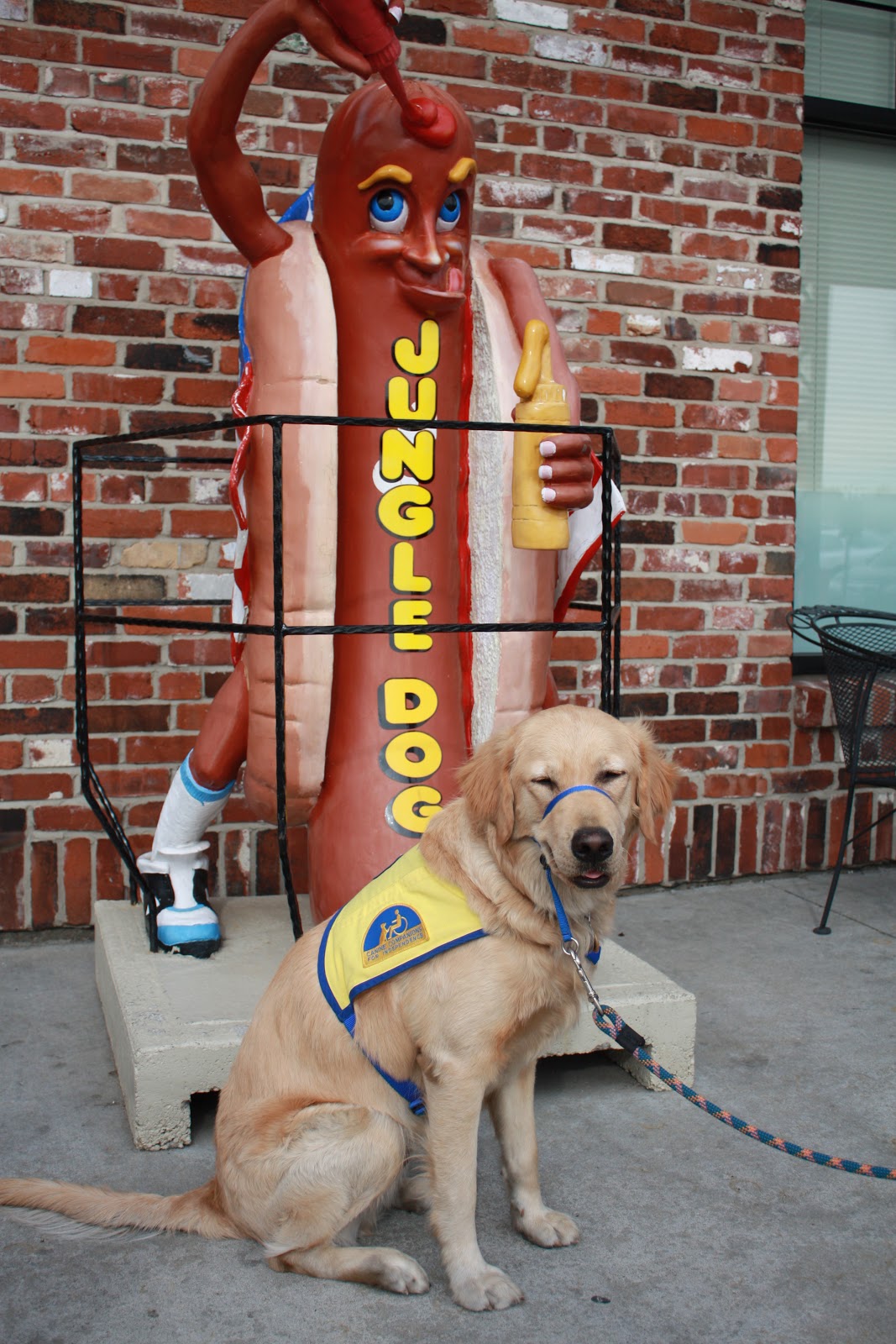
Here’s a favorite from the archives. A photo op at a for-real and everything restaurant in our local burg.  Micron was his usual good sport self and struck a pose for the camera. Unfortunately, he blinked.

Or did he?  Perhaps he is indeed enjoying a delicious tube steak daydream.  If I had the ounce of talent it would take, I’d put a thought balloon over his head with a hot dog floating inside.

Any clever ideas for a caption ideas for this dreamy shot?

Working Dog face

At the tender age of five months, we slipped the working cape over Micron’s noggin and snapped the clip under his belly. You’re not a little puppy anymore, we tell him, it’s time to start acting like a big dog now.
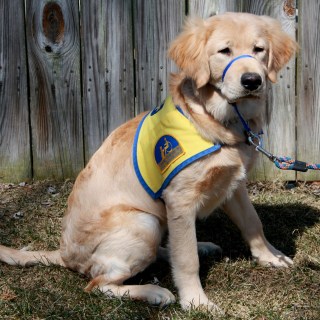
The Mighty Micron at five months

I capture this momentous occasion with a snapshot. To the uninitiated, this may appear to be a pup taking things serious. I’m a big dog now!  See that look of focus on his adorable button-nosed face?  Ah, but look again. That wide legged stance, alert posture. Those brown eyes are indeed focused, but alas not on either of his handlers. Now people, what one word comes to mind when you look at this?  Right. Ok, let’s all say it together, shall we  . . .

Squirrel!

Yep, the distraction factor, just one of the behaviors that makes Micron so charming.

As we were out and about to socialize this fluffy boy over the next year, we’d be asked, so, what do you think he’ll be doing?  A good question that. Of the four types of assistance dogs that Canine Companions for Independence trains and provides, where did we feel Micron would fit? As volunteer puppy raisers, we don’t socialize and train for any one specific purpose. We move forward with our eye on the horizon and try our best to get the pup ready for the Advanced Training program at CCI.  Once there the professional trainers work with the dogs for another six to nine months to determine how their skill sets and personalities best fit in the assistance dog world.

But sure, it’s fun to fantasize about the destiny of the pup in your charge. Of course, it turned out that thinking that Micron would make it through more than three months of Advanced Training was my own personal fantasy. But long before being faced with stark reality, I’d squint my eyes and picture him as a Service Dog or Skilled Companion Dog. Oh, that would be glorious!  But truth be told, that vision was a little blurry. Holding onto that warm thought was like nailing jello to a wall.  It just didn’t feel right. As a pup, Micron just never took anything seriously. Walking into a room, any room, it was like he would throw out his front paws and shout, That’s right, people! The party starts . . . NOW!

Ok then, so what about a Hearing Dog? Well, kinda the same thing I guess. Hey! Hey! he’d nudge to alert his person, didja see it? There’s a squirrel!  I’ll be right back.   No, I suspected CCI’s high value system wouldn’t be able to overlook this behavior. There’s a very specific personality that’s required to be a Hearing Dog and tree rat retrieval isn’t gonna be a required skill.

Even on matriculation day, Micron jokes
with Karsen about picking up chicks at college.

Which leaves the role of Facility Dog. Now, this one gave me a tinkling spark of hope. Micron loves people and basks in any attention he receives. It’s hard to describe really, but it’s kinda like he glows. No, not like emitting a light, but maybe more like an aura about him. People tell me they feel better being near him, by petting him. Now if I could just bottle this magical stuff he has, we could share it and make the world a better place.

When talking with folk about CCI dogs, it seems most have some understanding of the work of Service Dogs, Skilled Companion Dogs and Hearing Dogs. These are teams you come across in daily life in the public arena of the world. A Facility Dog, however, doesn’t get out as much into the public eye.  Not that they’re behind the scenes, mind you. These dogs earn their kibble.  From CCI’s website, we learn . . .

Facility Dogs are expertly trained dogs who partner with a facilitator working in a health care, visitation or education setting.

CCI Facility Dogs are trustworthy in professional environments and can perform over 40 commands designed to motivate and inspire clients with special needs.

Facility Dogs are needed in educational settings, such as special education classrooms. And an amazing program that’s really been taking off over the past few months are the Courthouse Dogs, who promote a feeling of calm and security in a visitation setting. My fellow dog lovin’ friends, you can certainly see this, right? Imagine a child about to testify in a courtroom. A stressful situation for any of us, but for a kid with less life experience this can be downright terrifying. Now imagine being able to stroke a calm, friendly Labrador before you walk out there to take your place on the witness stand. No really, close your eyes and think about this. Can you feel the difference it makes? Absolutely incredible stuff, I think.

And in the healthcare setting, our CCI Facility Dogs are trained to assist with medical rehabilitation.  They are there to motivate and encourage folk to pull through otherwise difficult tasks. How so? you ask. Ah, another good question. Well, let me share something pretty darn cool with y’all.

The ruggedly handsome Jarvis was teamed with Margie Benge of Triangle Therapy Services in February, 2012.  For those of you out there on Facebook, I invite you to check out Triangle Therapy Service’s page, especially the photo album on Jarvis – First month at work. Margie’s photos tell the story of the important job of a dog involved with occupational therapy with children. Talk about the Wow factor.

If you’re not on Facebook, then what the heck are you doing with all your spare time anyway? Cleaning the house or something? No what I mean is, check out their website at Triangle Therapy Services to learn more about their pediatric occupational and speech therapy work.

After Micron’s turn in to CCI’s Advanced Training program, I held onto the Facility Dog dream for a while. Actually, for three whole months until The Phone Call.  But, I plead, he loves people!  He has an aura and everything! Can’t he be a Facility Dog?  To which Gwen replies, Yeah, it was a nice try, Donna. But there’s too much Microness there.   Too much Micron happening? Sure, I can see that.  Heck, I lived with it for eighteen months, so the news was not a shocker.
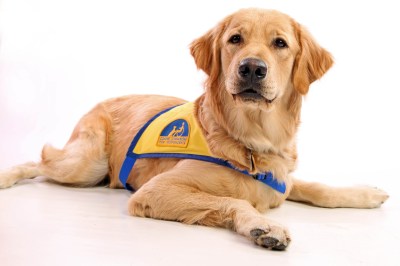
What? This is my Serious Look [snort]

What to do with this college dropout?  Well, that’s where the pet therapy training comes in.

At a glance, there could be some connection seen between a CCI Facility Dog and a dog involved in a Pet Therapy program. In the world of assistance dogs, there’s even some ambiguity with terms among different organizations just to keep us all a bit confused. Lessee if I can help with this without making things worse.

Both occupations require a calm, confident dog. A canine who is at their best around people. A good start, but let’s summarize the nitty gritty of things to see what’s really different here.

A Facility Dog’s work is goal oriented.  The dog is highly trained dog to guide an individual – adult or child – with a specific task. Such as physical rehabilitation, in which the dog is assisting an individual in improving a motor skill or relearning how to use certain muscles after an injury. This type of work is termed as Animal Assisted Therapy (AAT), bringing the term therapy as another ingredient into the confusion soup. Some of CCI’s Facility Dogs are indeed assigned to AAT work in healthcare. But you recall that other Facility Dogs may be working in a courtroom environment or elementary classroom.  All assignments, however, are goal oriented.
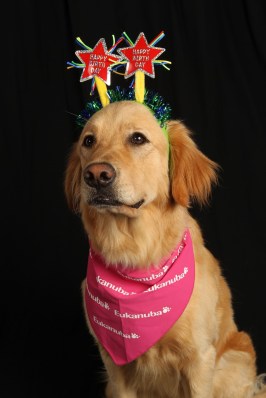
How ’bout this? My mouth is closed.
Serious enuf for ya now?

Now a dog involved in Pet Therapy is pretty much what the title says. A person and their pet dog who goes out to make the world a happier place. A noble goal to be sure, but not the goal oriented work of a Facility Dog. What this team does is more recreational.  Showing up to bring a smile to someone. Ask anyone who’s had their day changed after a visit by a pet therapy team and you’ll understand the value of the program. I’m telling you from experience, the training is tough. No doubt there. But it is a different focus on skill sets for you and your dog.  In our pet therapy course, we’re reinforcing good behavior and basic obedience skills. We’re not doing anything especially fancy here. With me and Mike, our thing is encouraging party boy to show some self-control. Like not trying to take the yellow tennis balls off the feet of the walker.  While someone is using it.

So in the past I was telling Micron to stop it already with the goofy looks and put on your working dog face, because darn it, you’re wearing your cape and you’ve got to look serious, and well . . .

Today I can look into those sparkling brown eyes and smile back at his open mouthed doggie grin. I know now this is his working dog face.  His job is to bring happiness into a room. Any room.

raising a super dog
There it is. Micron’s working dog face.
The one we know and love so well.

Wish us luck, won’t you?  Four weeks down and six more to go in our pet therapy training. So far, so good, but we need plenty of positive thoughts sent our way.  This dog has a destiny, you know.

Wordless Wednesday: Why we do this (Reason #1)

Inga IV and Joseph
(photo used with permission by Trib Total Media)

Joseph’s mom says this expression on Inga’s face is her this is my job and I have a purpose look. The lovely Inga takes her job very seriously, it seems.  As her puppy raisers, we’re just bursting to full with pride. 

She loves her job and just adores Joseph.

Good dog, Inga.

_____________________

The photo above is by the courtesy of Trib Total Media (Pittsburgh Tribune-Review, Sunday, Feb 26 2012). To read the entire related story, including photo gallery and video, go to:
Service dogs provide aid for disabled, support for wounded, grieving

The dog has a busier social calendar than I do

Alright everybody, says the Therapy Dog Handler while pointing at me, everything she just told you, I’m gonna tell you the exact opposite.

Yeah, she’s talking about me, but no malice is intended. Indeed this gentle lady speaks the truth. I had just finished talking to a group of young people about assistance dogs and their incredible feats of derring-do.  This was way back when the mighty Micron was a young CCI pup in training and we still had fantasies of him graduating the program. And to be rather honest, until this particular day I had not given a Therapy Dog program much thought.

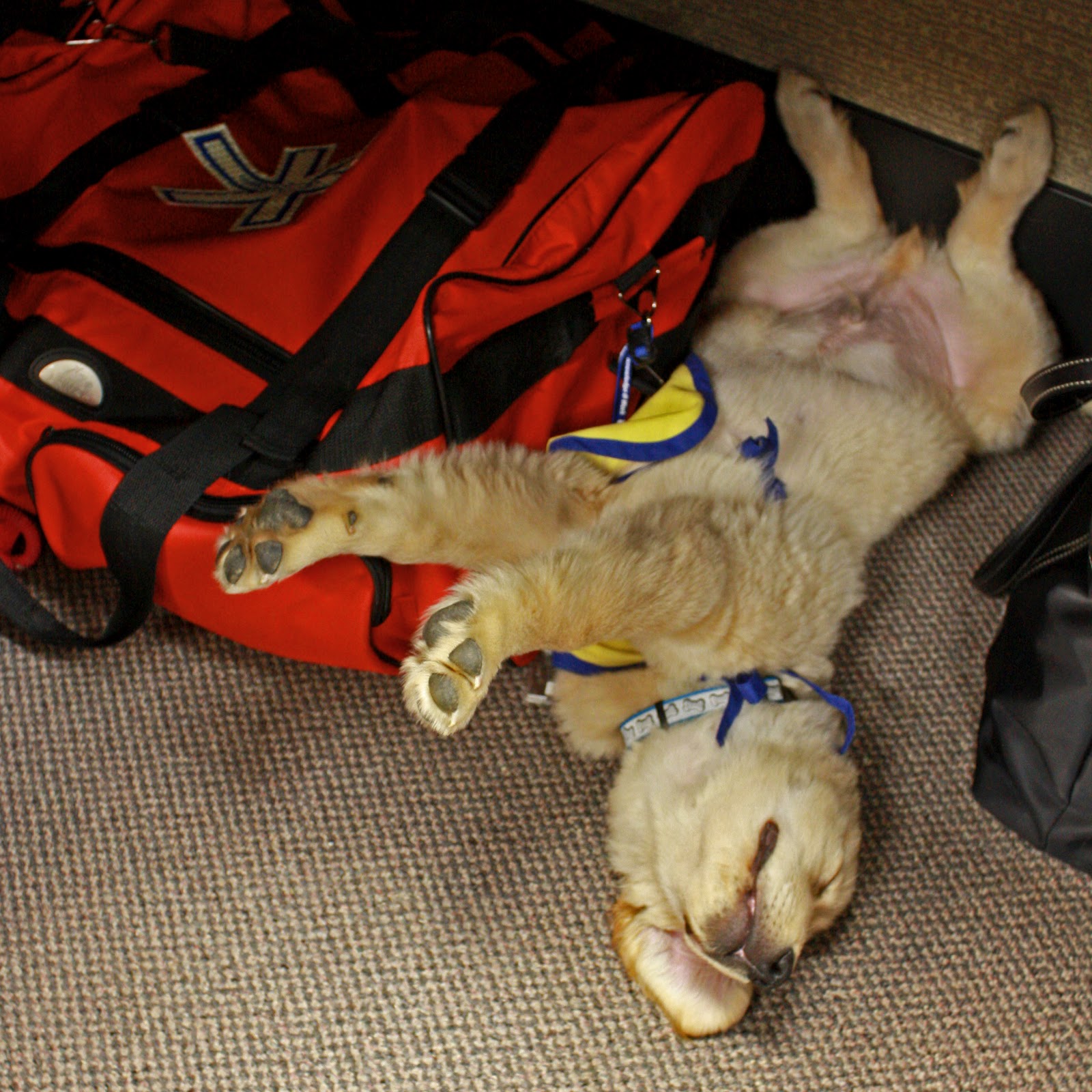
Micron started working on his relaxation techniques at an early age.
He’s now reached proficiency.

So the contrary comment grabbed my attention. Opposite, she says?  Ok, I’m listening.

Now, our young audience had observed as Micron did a fine job of demonstrating the focus an assistance dog must have. How the dog must be dialed into their handler and follow all directions as asked. Distractions are tuned out, whether other dogs, people or even a morsel of food on the ground. The dog and handler share a bubble, so to speak.  Everything outside is just a buzzing noise.

Yeah alright, I’m exaggerating here. This is Micron, y’all.  Focus is not a word found in his canine dictionary. Especially as a young yeller feller, he had the attention span of a goldfish – about three seconds. But he did try really hard, bless his heart.

Focus, however, is the point we made to our attentive audience. The essence of a successful Assistance Dog team, I say. 

And here is exactly where things are different for a Therapy Dog.  It was an awakening to see the handler remove the leash from Leela, a tail waggin’ black Labrador, to allow her to walk freely among the kids.  Leela calmly greeted each kid, sometimes spending more time with one than another. I learn that she is reading the kids, checking their moods and their responses to her attention. Over the next few minutes, Leela makes her choice from our audience of fifteen and settles down to lie at the feet of a boy. He slips from his chair to the floor to hug her. And there they remain there for the rest of the presentation. The boy smoothly petting the dog’s back with her head resting on his lap. Why this particular boy and what was churning through his young noggin? Only he and Leela know for sure.

So here we have two types of working dogs doing God’s work in very different ways. They have their own unique -and essential- gifts to offer in our world of human beans. 

Because these are dogs interacting in our world of people, there are indeed a few similarities. More than pets, any working dog is held to a higher standard. I’m not talking just about the wow factor of things. But instead the foundation that we start from. These pups must be tipping the scale on their obedience skills. And be way up there on that very basic qualification of any well-behaved, trustworthy dog.

Socialization.

A well socialized dog is a dog confident in a stressful situation. To be able to carry on in a environment where things just ain’t right in a dog’s eyes is not a natural state of mind of many of our canine friends.  Early socialization, while keeping an eye out for those puppy fear periods, is the making of a good companion you can enjoy in the public arena of life.

As a kid, our dogs were working canines of yet another ilk. Farm dogs who each had a purpose as protectors of the realm with such tasks as keeping the chicken coop weasel free. But outside dogs, the lot of them. So when all grown up with a house of my own, I manage to convince the Husband that marital bliss can only be fully achieved with a pet dog. Just like having kids, the first one is the practice one where you make all your mistakes. We didn’t socialize Jack the Wonder Dog and spent the next thirteen years suffering the consequences. Not fear behavior from this lovable mutt, mind you. We’re talking complete abandonment of self control. Picture a cub scout tanked on Mountain Dew and Reese Cups. And running around a campfire with a stick on fire. It was like that. All the time. We loved the fella and his heart of gold, but darn it, could not take him anywhere without abject embarrassment.

And again, like having more kids, you start paying attention to the things that do matter (like good manners) and less about the stuff that doesn’t (just blowing the dirt off the pacifier instead of boiling the thing).  With our next dogs, we got them all out and about early in puppyhood. Obedience classes, visiting friend’s houses, vacations in the RV, and meeting other friendly dogs. So by the time we got our first CCI pup and put the training cape on her, we were off and ready. Let’s do this thing, we said.

Our second CCI pup was, by gosh and golly, well socialized. Micron does remind us at times of Jack the Wonder Dog, both with handsome golden looks and silly antics. The comparison stops short about right there, though.  From the tender age of eight weeks, Micron was systematically introduced to the new and different. At two years old, we find ourselves hard pressed to find something that would cause Micron to do a spit-take. No longer permitted to wear a CCI training cape, our public visits happen less these days. But Micron is still welcome at the assisted living facility to visit a family member. So much so, we find ourselves in a sticky situation if we darken their doorway without his fuzzy company.  And where’s Mike?, they all ask accusingly, is he sick or something?  Like he better be, because there’s no other acceptable excuse to not bring his smiling face and wagging tail into their world.

A doggie social event.
Ruh roh, looks like a terrier crashed this Yellow Dog party.

Sure, I still make mistakes with our dogs, even the CCI pups in training. I’m merely a human bean, after all. We people seems to run more on emotions more than instinct, don’t we?. But the one thing I’ll never screw up on again with a dog is early socialization.  We learned a hard lesson with Jack the Wonder Dog. Who, just by the way, would answer to the name of Awwshitjack with a smiling face and wagging tail.

Sometimes new and different is well,
more different than others.

Oh, and for those paying close attention to my wisdom about having more than one kid, you are certainly aware that I’m speaking hypothetically.  My only son endured his childhood as my practice kid. Sorry about your lot in life, Kiddo, but take comfort in the knowledge that you are indeed my Favorite. Some of us have to fiercely compete for that honor with our siblings. Not that we still do, of course.

Uh huh. Yeah, right.